It’s important that pressure injuries be kept clean, moist, and covered. This helps reduce the risk for infection and speeds up the healing process. To promote healing, clean pressure injuries at each dressing change. Take care to choose the most appropriate type of cleanser and dressing.
Caution
-
Don't use heat lamps or drying agents, such as alcohol. They dry out wounds and can kill fragile new tissue.
-
Don't use antiseptic agents, such as povidone-iodine and hydrogen peroxide, because they are toxic to new cells.
-
Be aware that if dressings become dry, they may fuse with new cells, causing loss of new tissue when dressings are removed. Remove or change dressings before they dry out.
-
Silver-based dressings are very effective for killing bacteria early on in infected wounds.
-
Offloading of pressure on affected sites is essential for promoting wound healing by other methods.
Wound irrigation
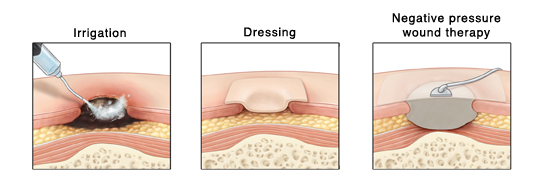
An irrigating catheter or syringe and saline may be used to flush the pressure injury free of debris. Wound cleansers may also be used to loosen up and clean out debris. The amount of pressure used during irrigation should be enough to clean the wound without damaging it. Follow your facility’s guidelines regarding irrigation.
Adding moisture
Maintaining a clean, moist wound bed is essential for promoting healing. Certain dressings help keep pressure injuries moist. Be sure to fill spaces loosely with dressings to prevent fluid and bacteria from building up. Hydrogels can also help retain moisture.
Types of dressings
Many kinds of dressings are available. Be sure to follow the manufacturer’s instructions for the specific dressing used. If a wound doesn’t respond to one type of dressing, another type of dressing may be used.
-
Moist gauze helps keep the wound moist and absorbs excess fluid. Gauze should be damp—not wet—with saline. Too-wet gauze can weaken surrounding tissue.
-
Transparent films are thin and flexible and help protect wounds from water and bacteria.
-
Hydrocolloids absorb exudate, forming a nonadhesive gel. This helps maintain a moist wound environment. Hydrocolloids also protect the wound from water and bacteria.
-
Hydrogels are water-based gels and dressing sheets that keep wounds moist. They are also soothing and can help ease pain.
-
Alginates are highly absorptive dressings made from seaweed. When combined with wound exudate, the dressing may form a gel that helps maintain a moist wound bed.
-
Foams absorb exudate and keep the wound moist. They are used to cover or fill wounds. They are particularly good for wounds that have odor.
-
Collagens absorb exudate and help maintain a moist wound environment. They may also promote new tissue growth.
-
Antimicrobials help prevent and treat infection. These dressings come in many forms.
Negative pressure wound therapy
Negative pressure wound therapy (NPWT)—also called vacuum-assisted closure, or wound vac—removes exudate, helps reduce bacterial growth, and promotes blood flow and granulation formation. First, a foam dressing that is fit to the wound is placed in the wound. The wound is covered with an occlusive dressing that has tubing attached to it. The tubing is attached to a pump, which creates subatmospheric pressure in the wound. Keep in mind that patients may require analgesia, as dressing changes can be painful.