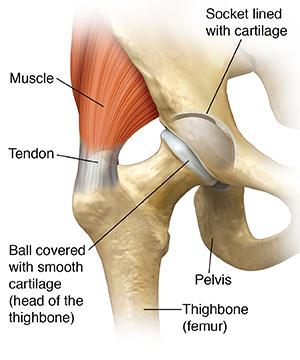
The hip joint is one of the body’s largest weight-bearing joints. It is a ball-and-socket joint. It keeps the hip stable even during twisting and extreme ranges of motion. A healthy hip joint allows you to walk, squat, and turn without pain. But when a hip joint is damaged, it is likely to hurt when you move. When a natural hip must be replaced, a prosthesis is used.
A healthy hip
In a healthy hip, smooth cartilage covers the ends of the thighbone, as well as the pelvis where it joins the thighbone. This allows the ball to glide easily inside the socket with little friction. When the surrounding muscles support your weight and the joint moves smoothly, you can walk painlessly.
A problem hip
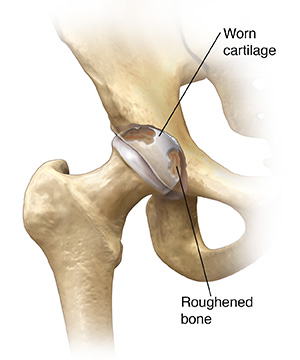
In a problem hip, the worn cartilage no longer serves as a cushion. As the roughened bones rub together, they become irregular, with a surface like sandpaper. The ball grinds in the socket when you move your leg, causing pain and stiffness.
A prosthesis
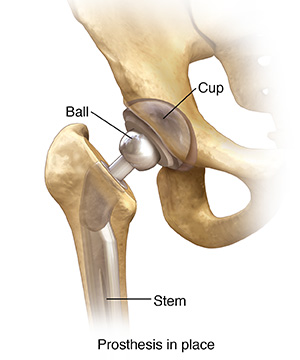
An artificial ball replaces the head of the thighbone and an artificial cup replaces the worn socket. A metal stem is inserted into the thigh bone to keep the ball in place.
These parts connect to create your new artificial hip.
A liner, usually made of plastic or ceramic, is placed between the metal or ceramic ball and cup to create a smooth surface for comfortable movement once you have healed.

Orthopedics CTA
Find a DoctorRelated Articles
Understanding Lateral Ankle Ligament Reconstruction
Lateral ankle ligament reconstruction is a surgery to tighten and firm up 1 or more ligaments on the outside of the ankle. Learn more about this surgery.
Kneecap Surgery: Removing Damaged Cartilage
Surgery may be used when pain severely limits your activities. Or it may be done when a rehab program or other nonsurgical treatments just are not helping enough. Some procedures may be done using arthroscopy. This method uses tiny incisions and special instruments to look and work inside the knee joint. Other procedures need open surgery.
Understanding Clavicle Fracture Open Reduction and Internal Fixation (ORIF)
Open reduction and internal fixation (ORIF) is a type of treatment to fix a broken bone. It puts the pieces of a broken bone back together so they can heal.
Foot Surgery: Curled Fifth Toe
A curled fifth toe is most often inherited. When the fifth toe curls inward, it moves under the next toe. Then the nail of the curled toe starts to face outward. As a result, you may bear weight on the side of your toe instead of the bottom. This can cause corns and painful nails. There are many nonsurgical treatments available. But if these are not effective, surgery is a choice.