Your treatment will depend on how inflamed your tendon is. The goal is to ease your symptoms and help you regain full use of your elbow.
Rest and medicine
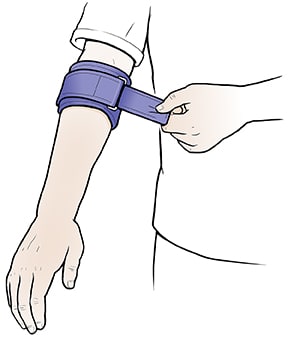
Wear a tennis elbow splint to let the inflamed tendon rest and heal. It must be worn correctly. It should be placed down the arm past the painful area of the elbow. It can make symptoms worse if it's directly over the inflamed tendon. Take stress off the tendon by using your other hand or changing your grip. Take NSAIDs (nonsteroidal anti-inflammatory drugs) for pain and inflammation. Talk with your doctor before taking these if you have chronic liver or kidney disease or had a stomach ulcer or digestive bleeding. Also talk with your doctor if you take a blood thinner.
It may be helpful to use an ice pack for the first
Exercises and therapy
Your doctor may give you an exercise program. They may send you to a physical therapist. That expert will teach you how to gently stretch and strengthen the muscles around your elbow.
Anti-inflammatory shots
Your doctor may give you shots of an anti-inflammatory medicine, such as cortisone. This helps ease swelling. You may have more pain at first. But your elbow should feel better in a few days.
Another option is a shot called PRP or platelet rich plasma. This is a specialized injection that uses a sample of your own blood to inject growth factors into the damaged tendon to try to allow it to heal.
If surgery is needed
If your symptoms go on for a long time, or other treatments don't work, your doctor may recommend surgery. Surgery releases the inflamed tendon, taking the tension off the tendon.

Orthopedics CTA
Find a DoctorRelated Articles
Knee Arthroscopy
Arthroscopy is used to diagnose and treat knee problems through several small incisions in the knee.
Foot Surgery: Plantar Fascia Problems
Your plantar fascia is the ligament that extends from the heel of your foot to the ball of your foot. If your foot flattens too much or too little as you move, you may strain your plantar fascia. While the vast majority of people with plantar fascia pain can be helped with nonsurgical treatments, surgery can be considered if these treatments fail.
Shoulder Arthroscopy: Conditions Treated
Arthroscopy is used to diagnose and treat shoulder problems. Conditions treated by shoulder arthroscopy include impingement, torn rotator cuff, stretched capsule, torn labrum, arthritis, and loose bodies.
First Aid: Sprains and Fractures
A sprain happens when ligaments, the fibrous tissues that connect bones at a joint, pull or tear. A fracture may happen when a bone is hit with more force than it can bear. Learn about first aid for a sprain or fracture.