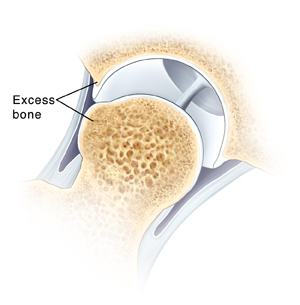
When excess bone has formed on the edge of the ball (femoral head) or the socket (acetabulum) of the hip, it's called femoroacetabular impingement (FAI). FAI can cause pain and limit movement. Arthroscopy can fix FAI with only small incisions and special tools.
In the operating room
Just before surgery, you may be asked several times which hip is to be treated. This is a standard safety measure. In the operating room, you will likely receive general anesthesia to make you sleep.
During the procedure
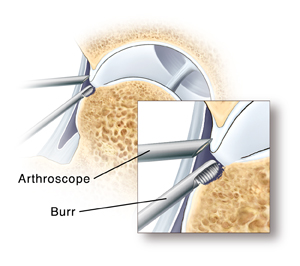
After you receive anesthesia, your leg is gently pulled to distract, or widen, the hip joint. Next, the surgeon makes a few small incisions. These are called portals. The surgeon puts surgical tools, including the arthroscope, through these portals. The arthroscope sends images of the joint to a video screen. These images let the surgeon see inside the joint. The joint is filled with sterile fluid to help the surgeon see more clearly.
Treating FAI
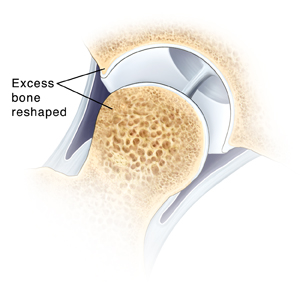
To treat FAI, the area is reshaped by taking out excess bone. Excess bone can be taken from the socket side or ball side of the hip joint, or both. FAI can lead to cartilage problems, such as labral tears or chondral damage. If present, these problems are also treated. Once the surgeon is done, they close and bandage the portals. Then you are taken to the recovery room.

Orthopedics CTA
Find a DoctorRelated Articles
Achilles Tendon Repair Surgery
Achilles tendon repair surgery is a type of surgery to fix a damaged Achilles tendon. Learn more about the surgery, including why you might need it, what the risks are, how to get ready for it, and what happens during and after the surgery.
Femur Fracture Open Reduction and Internal Fixation
Open reduction and internal fixation (ORIF) is a type of surgery used to stabilize and heal a broken bone. You might need this procedure to treat your broken femur. Read on to learn what to expect before, during, and after this surgery.
Spinal Fusion: Posterior Lumbar
Fusing vertebrae in the lumbar curve spine may help ease lower back and leg pain. Posterior lumbar fusion is done through an incision in your back. The graft is put between the vertebrae in one of two places: in the disk space or between the transverse processes.
Colles Wrist Fracture, Reduction Needed
You have a break (fracture) of the forearm bone (radius) where it attaches to your wrist. This type of fracture may be called a Colles fracture. The bone is out of place. It must be set (reduced) to make it straight again. Learn about how to care for yourself at home.