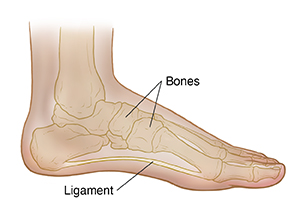
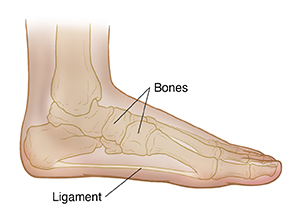
You may have noticed your child’s feet were flat when you saw their footprints in sand. Or you may have noticed this if your child walked on a flat surface with wet feet. The curved parts of the bottom of the feet are called arches. They are like a bridge made of bones joined together by ligaments. They help absorb the shock of walking and spread weight on the feet. Some children develop arches as their baby fat disappears. But some children don’t. This is still considered normal. It's often not a cause for concern.
Understanding arch development
Many children’s feet have arches when their feet are off the ground. But they may have flat feet when standing. This is due to loose arch-supporting ligaments in the feet. Your child's doctor inspects your child’s arches when they’re in the air and on a flat surface. If your child has painful flat feet, they may need X-rays to figure out the best type of treatment.
Caring for your child
Over time, your child’s feet may or may not develop arches. If not, it usually doesn’t affect the way your child walks or runs. Your child’s doctor may suggest you go ahead and let your child play sports and other activities.
In some cases...
If your child has painful flat feet, the doctor may advise arch supports or special shoe inserts. These can help ease pain. The doctor may also advise an orthopedic surgeon if your child has bone problems. Sometimes physical therapy can provide your child with exercises to strengthen loose ligaments and ease pain.
Featured in

Orthopedics CTA
Find a DoctorRelated Articles
Plaster Cast Care (Child)
A cast keeps a broken bone in place so it can heal. Plaster casts are heavier than fiberglass casts. But plaster casts shape better. This gives better support for certain fractures, such as broken bones in a hand.
Dislocated Finger (Child)
A dislocation occurs when the strong bands of tissue that hold the bones of a finger joint together tear. This lets the bones move apart and out of place.
When Your Child Has Spondylolysis or Spondylolisthesis
You have been told your child has a problem with their vertebrae. These are the bones that stack together to make up the spine. Spondylolysis is a crack (defect) in the back part of a vertebra. Spondylolisthesis is the slipping forward of a vertebra. Here is information on the causes, symptoms, diagnosis methods, and treatments.
Open Finger Fracture (Child)
A finger fracture is a broken finger bone. With an open fracture, a broken bone is exposed by a break in the skin. Because of this, there is a risk of infection to the skin or bone. Learn how to care for your child's open finger fracture at home.