Dismiss Modal

Types

Polycystic Ovary Syndrome

Choose a preferred language

Polycystic ovary syndrome (PCOS) causes harmless, small cysts in the ovaries and other symptoms. PCOS is caused by certain hormones being out of balance. The word syndrome means a group of symptoms. Women with PCOS may have no periods, irregular periods, or very long or heavy periods.


Your ovaries

Women store their eggs in their ovaries. Each egg is in a capsule called a follicle. Normally during the reproductive years, one follicle grows to make a mature egg each month. This egg is released during ovulation and the follicle dissolves.
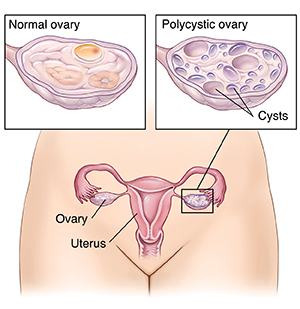
Front view of female reproductive tract with insets showing normal ovary and polycystic ovary.


Hormones out of balance

With PCOS, the hormones that control ovulation are out of balance. These include estrogen, progesterone, and androgen. As a result, ovulation may not occur. Instead, the follicle stays enlarged. This is a fluid-filled sac called a cyst. Over time, the ovaries fill with many small cysts. This is why they are called poly or many cystic ovaries. In some women, the ovaries also make too much androgen.


Symptoms of PCOS

Women with PCOS may also have one or more of these symptoms:

  • Acne

  • Hair growth on the face and other parts of the body

  • Patches of thick, velvety, dark skin (acanthosis nigricans), often on the neck or groin area

  • Trouble getting pregnant (fertility problems)

  • Weight gain, often around the waist 

Women with PCOS are also at greater risk of having cancer of the uterine lining, diabetes, and heart disease.

Featured in

© 2000-2026 The StayWell Company, LLC. All rights reserved. This information is not intended as a substitute for professional medical care. Always follow your healthcare professional's instructions.
Related Articles
Read article
OB/GYN
Understanding Dilation and Evacuation (D&E)

Dilation and evacuation (D&E) is a procedure to end a pregnancy in the second trimester. It may be done for many reasons.

Read article
OB/GYN
Premenstrual Dysphoric Disorder (PMDD)

Premenstrual dysphoric disorder (PMDD) is a much more severe form of premenstrual syndrome (PMS). It may affect women who are able to get pregnant. It’s a severe and chronic medical condition that needs attention and treatment. Lifestyle changes and sometimes medicines can help manage symptoms.

Read article
OB/GYN
The Range of Pap Test Results

When your Pap test is sent to the lab, the lab studies your cell samples and reports any abnormal cell changes. Your healthcare provider can discuss these changes with you. In some cases, an abnormal Pap test is due to an infection.

Read article
OB/GYN
Bartholin’s Cyst (No Infection)

When the opening of a Bartholin's gland becomes blocked, the gland may swell and form a cyst. The cyst may vary in size from 1 to 3 cm. It may feel like a firm lump in the labia.