Sound moves through the air like the ripples you see after throwing a stone into a pond. Your ears collect these waves of sound around you and send them to your brain. This is how the parts of your ear work so you can hear.
Three parts of your ear
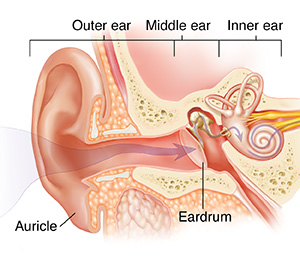
Your ear is made up of the following parts:
-
Your outer ear collects sound waves.
-
Sound waves enter the ear and hit the eardrum in your middle ear. Three tiny bones in the middle ear are set into motion.
-
This transfers sound waves to the fluid-filled inner ear. There, thousands of hair cells turn sound waves into nerve impulses. These impulses travel along nerves to your brain. When the impulses reach your brain, you perceive sound.
Damaged hair cells affect hearing
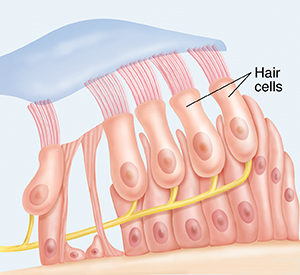
Hair cells move when incoming sound vibrates the inner ear fluid. The motion is turned into impulses that let you hear the sound.
Loud noise causes hair cells to move too much and can damage them. Flattened hair cells can't fully send nerve impulses to your brain. Once damaged, hair cells never recover.

Find Your Provider
Find a DoctorRelated Articles
Rhinitis
Rhinitis is when a reaction occurs that causes a stuffy nose, runny nose, sneezing, and itching. Most types of rhinitis are caused by inflammation. Here's what you need to know.
Common Middle Ear Problems
Your middle ear may have been injured or infected recently. Over time, certain growths or bone disease can also harm the middle ear. Left untreated, these problems often lead to lifelong hearing loss. Read on to learn more.
The Middle Ear
The middle ear is an air-filled chamber that lies behind the eardrum. Pressure in the middle ear changes to match air pressure outside of the eardrum. When inside and outside pressures are balanced, the eardrum is flexible and normal hearing is more likely. Problems happen when air pressure in the middle ear drops. This is often due to a block in the eustachian (u-STA-shun) tube, the narrow channel connecting the ear with the back of the throat.
Tinnitus
Tinnitus is the sound of ringing in the ears. It may also be described as roaring, buzzing, hissing, or clicking inside the head. The sounds may come and go. Or they may be ongoing. Read on to learn more.