Definition
Anatomy of the Shoulder
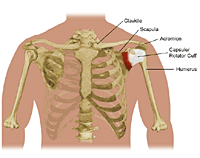
The shoulder is made up of several layers, including:
-
Bones. The collarbone (clavicle), the shoulder blade (scapula), and the upper arm bone (humerus).
-
Joints. The place where movement occurs, including the following:
-
Sternoclavicular joint (where the clavicle meets the sternum)
-
Acromioclavicular (AC) joint (where the clavicle meets the acromion)
-
Shoulder joint (glenohumeral joint). A ball-and-socket joint that helps with forward, circular, backward, and overhead movement of the shoulder.
-
-
Ligaments. White, shiny, flexible bands of fibrous tissue that hold joints together and connect various bones, including:
-
Joint capsule. A group of ligaments that connect the humerus to the socket of the shoulder joint on the scapula to stabilize the shoulder and keep it from dislocating.
-
Ligaments that attach the clavicle to the acromion
-
Ligaments that connect the clavicle to the scapula by attaching to the coracoid process
-
-
Acromion. The roof or highest point of the shoulder that is formed by a part of the scapula.
-
Tendons. The tough cords of tissue that connect muscles to bones. The rotator cuff tendons are a group of tendons that connect the deepest layer of muscles to the humerus.
-
Muscles. Help support and rotate the shoulder in many directions. Facilitate movement of the shoulder.
-
Rotator cuff. Name of a group of muscles and tendons that rotate and raise the shoulder.
-
Bursa. A closed space between 2 moving surfaces that has a small amount of lubricating fluid inside. It is located between the rotator cuff muscle layer and the outer layer of large, bulky muscles.

Orthopedics CTA
Find a DoctorRelated Articles
What Are Mallet, Hammer, and Claw Toes?
Mallet, hammer, and claw toes are among the most common foot problems. They are often caused by wearing shoes that are too short or heels that are too high.
Anatomy of the Sacroiliac Joint
Learn the anatomy of the sacroiliac joint.
Anatomy of the Male and Female Pelvis
The pelvis is a basin-shaped structure that supports the spinal column and protects the abdominal organs.
Your Neck Muscles
Illustration and explanation of neck muscles.